Friday, June 24, 2011
Thank You!
I just want to thank everyone for coming here and reading my post and giving me helpful feedback. This course has opened my eyes to things in the ECE field that I never knew before. It's been a pleasure working with you all, and I hope to see you in further classes!

Friday, June 17, 2011
Code of Ethics
"We shall use individually appropriate assessment strategies including multiple sources of information such as observations, interviews with significant caregivers, formal and informal assessments to determine children’s learning styles, strengths, and challenges" (The Division for Early Childhood, 2000).
Assessment is key to any program that involves children. I use assessment and observation in everything that I do so that I know my students are learning at the level they are at.
"We shall continually be aware of issues challenging the field of early childhood special education and advocate for changes in laws, regulations, and policies leading to improved outcomes and services for young children with disabilities and their families" (The Division for Early Childhood, 2000).
There are so many laws out there, that I honestly did not know existed. I want to become aware of all of these laws, regulations, and policies so that I can become a better teacher for my students.
"We shall use every resource, including referral when appropriate, to ensure high quality services are accessible and are provided to children and families" (The Division for Early Childhood, 2000).
There are resources everywhere and it is important to read as much as one can. I am an open minded person, and will listen to what anyone has to say, and then use what I know to make the best decision.
"To be familiar with the knowledge base of early childhood care and education and to stay informed through continuing education and training" (NAEYC, 2005).
I always want to be informed and I think a good way of doing this is through continuing my education. I like that my state requires teachers to take so many classes to renew your license.
"To create and maintain safe and healthy settings that foster children’s social, emotional, cognitive, and physical development and that respect their dignity and their contributions" (NAEYC, 2005).
This is very important to me and I plan to do this in any classroom that I am in.
References
NAEYC. (2005, April). Code of ethical conduct and statement of commitment. Retrieved June 14, 2011 , from http://www.naeyc.org/files/naeyc/file/positions/PSETH05.pdf
The Division for Early Childhood. (2000, August). Code of ethics. Retrieved June 14, 2011 , from http://www.dec-sped.org/
Thursday, June 2, 2011
Course Resources
Complete early childhood behavior management guide written by Kathleen Pullan Watkins and Lucius Durant. Jr.
This book was passed down to me from a teacher who retired and is now working with my mother. I found this book to be very resourceful as a first time teacher. It is set up to help with children ages one through nine and has quizzes for teachers to test them self on how they are doing.

A Child Called “It” written by Dave Pelzer
This book is a true story about a boy who was abused by his mother. This book opened my eyes and helped me see the warning sides that something is wrong at home. Here is a description of the book: “This autobiographical account charts the abuse of a young boy as his alcoholic mother first isolates him from the rest of the family; then torments him; and finally nearly kills him through starvation, poisoning, and one dramatic stabbing. Pelzer's portrayal of domestic tyranny and eventual escape is unforgettable, but falls short of providing understanding of extreme abuse or how he made his journey from ``Victim to Victor.'' It takes some work to get past the poor writing and the self-aggrandizing back matter, but the book tries fervently to provide a much-needed perspective. One of the greater obstacles to healing for males is admitting that they have been victims, especially if their perpetrator is a woman. This author has overcome that obstacle and succeeded in life by such masculine norms as joining the Air Force and receiving awards for his volunteerism. However, while personal accounts of child maltreatment provide crucial information about the realities of childhood, youngsters need insight and hope in order to digest the raw material of abuse” (http://www.amazon.com/Child-Called-Childs-Courage-Survive/dp/1558743669/ref=sr_1_1?ie=UTF8&qid=1307039694&sr=8-1).

This quote was given to my graduating class as we received our diploma in Bachelors of Science in Education and Allied Professions. I have it in a binder that has all my teaching resources that I want on hand when I teach.
“Children Learn What They Live”
By Dorothy Law Nolte, Ph.D.
By Dorothy Law Nolte, Ph.D.
If children live with criticism, they learn to condemn.
If children live with hostility, they learn to fight.
If children live with fear, they learn to be apprehensive.
If children live with pity, they learn to feel sorry for themselves.
If children live with ridicule, they learn to feel shy.
If children live with jealousy, they learn to feel envy.
If children live with shame, they learn to feel guilty.
If children live with encouragement, they learn confidence.
If children live with tolerance, they learn patience.
If children live with praise, they learn appreciation.
If children live with acceptance, they learn to love.
If children live with approval, they learn to like themselves.
If children live with recognition, they learn it is good to have a goal.
If children live with sharing, they learn generosity.
If children live with honesty, they learn truthfulness.
If children live with fairness, they learn justice.
If children live with kindness and consideration, they learn respect.
If children live with security, they learn to have faith in themselves and in those about them.
If children live with friendliness, they learn the world is a nice place in which to live.
Resources from our class
- National Association for the Education of Young Children
http://www.naeyc.org/ - The Division for Early Childhood
http://www.dec-sped.org/ - Zero to Three:
National Center
http://www.zerotothree.org/ - WESTED
http://www.wested.org/cs/we/print/docs/we/home.htm - Harvard Education Letter
http://www.hepg.org/hel/topic/85 - FPG Child Development Institute
http://www.fpg.unc.edu/main/about.cfm - Administration for Children and Families Headstart’s National Research Conference
http://www.acf.hhs.gov/programs/opre/hsrc/ - HighScope
http://www.highscope.org/ - Children’s Defense Fund
http://www.childrensdefense.org/ - Center for Child Care Workforce
http://www.ccw.org/ - Council for Exceptional Children
http://www.cec.sped.org//AM/Template.cfm?Section=Home - Institute for Women’s Policy Research
http://www.iwpr.org/index.cfm National Center
http://www.ncrece.org/wordpress/- National Child Care Association
http://www.nccanet.org/ - National Institute for Early Education Research
http://nieer.org/ - Pre[K]Now
http://www.preknow.org/ - Voices for
America
http://www.voices.org/ - The Erikson Institute
http://www.erikson.edu/
World Forum Foundation
http://www.worldforumfoundation.org/wf/about.php
This link connects you to the mission statement of this organization. Make sure to watch the video on this webpage- World Organization for Early Childhood Education
http://www.omep-usnc.org/
Read about OMEP’s mission. - Association for Childhood Education International
http://acei.org/about/
Click on “Mission/Vision” and “Guiding Principles and Beliefs” and read these statements.
Thursday, May 26, 2011
Quotes from three professionals
Dr. Edward Zigler
“It troubles me that most of the states are starting preschool at age 4. Most middle-class families send their children to preschool at age 3. That's when a child is ready for a preschool experience. It's particularly important for poor children. We have evidence from the National Institute of Early Education Research demonstrating that two years of intervention give you more benefits than one year So we want a program for 3- and 4-year-olds.”
“The United States
Dr. Marilyn Friend
“At the broadest level, collaboration is important in schools because it has become a defining characteristic of society in the 21st century. If you examine publications in business, health, social services, technology, and other major disciplines, you will find that collaboration is a unifying theme.”
“Teachers can help administrators understand the importance of collaboration by providing information, discussing its importance, undertaking collaborative initiatives that are as result of their own efforts. They also can participate in collaborative endeavors if they are personally satisfying.”
“The Passion for Early Childhood” Video
“The passion to make sure that all children were taught in environments and in ways that truly nurtured their ability to grow and develop to their fullest ability.” -Louise Derman-Sparks
I relate to this quote because this is one of my main goals in life. I believe that no child should be held back due to the environment that they are being taught in.
Refences:
Zigler, E. (2007). Giving Intervention a Head Start. Educational Leadership, 65(2), 8-14. Retrieved from EBSCOhost.
Brownell, M. T., & Walther-Thomas, C. (2002). Dr. Marilyn Friend. Intervention in School & Clinic, 37(4), 223. Retrieved from EBSCOhost.
Brownell, M. T., & Walther-Thomas, C. (2002). Dr. Marilyn Friend. Intervention in School & Clinic, 37(4), 223. Retrieved from EBSCOhost.
Friday, May 20, 2011
Personal Childhood Web
Ann Heiser
This is my mother. She is kind, caring, energetic, and a big kid at heart.
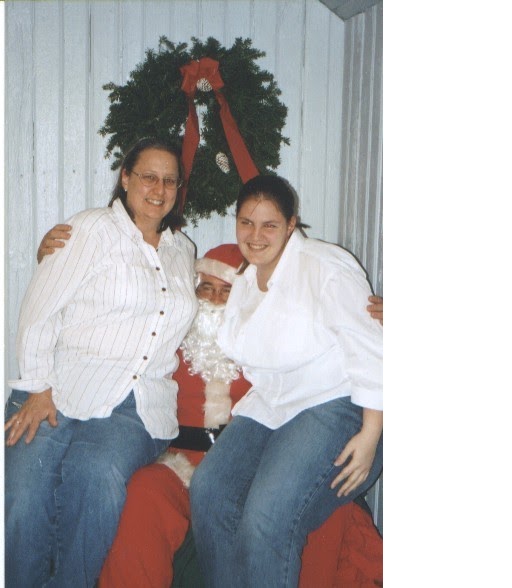
I was always in my mother’s shadow, so to say she had a part in my childhood is an understatement. My mother not only nurtured and cared for me, she was a friend to me while growing up and still to this day. My mother taught me many things in life but the two most important things were to stand up for what I believed in and to be myself. As
I stated above, my mother is a big kid at heart, and there was a time when I was embarrassed to be seen with her; mainly because of the way she acted. As I got older, I realized how much she enjoyed life and I came to the conclusion that you can’t hide who you really are. My mother made me feel special because even with her busy working schedule, she always had time to be there for me. She read to me at night, even though she felt she couldn’t read very well. She helped me with homework, even though she didn’t feel she was smart enough too. My mother not only pushed me to be the best that I could be, but she pushed herself so that she could help me with whatever I needed.
I believe that I am who I am today because of my mother. She is a major influence to my life and still makes me push for what I believe in. I talk to my mother about three times a week, and at least once throughout our conversation she is making sure that I am happy with what I am doing. She is also making sure that I am pushing myself to my fullest ability and loving life while doing it.
Richard Heiser
This is my father. He is a hard worker, smart, and realistic.

I was a huge daddy’s girl growing up and still am today. I remember when I was younger, turning on my dad’s stereo and listening to the song, “Daddy’s Girl” sung by Red Sovine. I could listen, sing, and dance to that song for hours. Even at a young age, I knew how important my father was to me and my family.
My father worked a lot of long and hard hours and when he got home, it was known to leave him alone so that he could relax. Even though he was tired, my father always made the time to sit down with me and help me with my homework or sit down and play with me. My father taught me to be a strong, independent woman who knew right from wrong. He taught me to be realistic about the world and that life wasn’t always fair. I remember while growing up, my brother and I would always hear the saying, “You can’t always get what you want” (The Rolling Stones, 1968). When he was in a playing, sarcastic mood, he would walk around the house singing that song over and over again, until we stopped asking for something.
My father influences me today by still being there when I need him. One saying that always stuck in my head from my father was, “if you want the truth about something come ask me” My father was always blunt and to the point and when you needed advice that was going to help, you always went to him. He has helped me get through schooling and get through working at jobs where I felt I couldn’t go on. Due to this, I am the type of person who always has to tell the truth, even if it will hinder me.
Charlotte Heiser
This is my Nana or grandmother. She is strong, family oriented, and caring.

My Nana was like a second mother to me. She had a major part in my up bringing because I was always with her when I could be. All while growing up my Nana made me see that family was everything in life and that you had to cherish everything that you have and love. She also taught me to let things go and to not hold on to conflicts. Any time that I had a problem, I could go to my Nana and tell her what was going on. She would sit and listen and then tell me what she thought. In the end, it always came down to that life was short and you could not hold on to the small things.
When my Nana was diagnosed with pancreatic cancer she was told that she only had a few months to live. Not only did she live past those few months, she lived almost a year and a half later. Her determination to prove people wrong and her strength to keep going, let her meet her first grandson and to see his first year of life. We are so grateful for the time we had with her and she showed me that if you are determined to do something, you just have to work hard at it and it will happen. My Nana was a strong woman and I believe that my strength today comes from her. She taught me to cherish the things that I have and I am grateful to take the knowledge she gave me and pass it down to my future kids one day.
Ken Moehl
This is my Uncle Ken, or as I called him, Papa Ken. He is strict, funny, a handy man, and loved the military life.

Papa Ken was my godfather and like a second father to me. He watched me when my parent’s were working and on weekends when I wanted to come and stay the night. My Papa Ken taught me that I could be anything that I wanted to be. He taught me to work hard at school and do my best and I could choose any career out there. He cared for me just like I was one of his own children. The one thing that I remember the most about him, was all the camping trips I used to go on. At least once a summer we go to a campsite and I would help him get the pop up camper up and running and we would spend the weekend boating, fishing, and making s’mores.
Papa Ken influences me today because I took his hard work ethics and put it towards my schooling and my career.
Tamara Moehl
This is my cousin. She is fun, caring, and a big kid at heart.

Tammy is not only my cousin but my godmother. She lived with us for about a year when I was young. She cared for my brother and me when my parents were working and when they would have their date nights. Even as Tammy got married and had children she was still a major part of my life. She constantly invited me over to hang out and trusted enough in me to watch her children. Tammy taught me how to cook, bake, and sew, which is something that my parent’s couldn’t really teach me. Tammy was also always there to listen to me when I had problems at home. She never judged me and would always try to help me see both sides of a story. She also would always tell me the truth about things that I wanted to know. Growing up, my parents would “sugar coat” things that happened in our family because they didn’t think I could handle the truth. But she knew that I could and would talk to me like an adult and would answer any question I had. When my Papa Ken was killed, I had so many unanswered questions that my parents would never answer. I knew that by going to Tammy she would tell me anything that I needed to know so that I could gain closure with what happened.
Tammy has influenced me today because I learned to tell children the truth about things in ways that they would understand.
References: The Rolling Stones. (1968). Let It Bleed [CD]. London, England: Olympic Sound Studios.
Monday, May 9, 2011
Favorite Children's Book
One of my most favorite children's book is, Oh The Thinks You Can Think! by Dr. Seuss. I love to read this story to children because it is a great sources for rhyming with nonsense words. When learning how to rhyme, I think it is great to show a child that we can play with letters and sounds to make up funny words or sayings. I also love this book because it lets the children know that they can imagine anything that they want. It helps them to think outside the box and to let their imagination and creativity run free. After reading the book to a set of children, I like to sit down with them and brainstorm how we could add to the story. The things that the children come up with are fun and exciting. By the end of our discussion everyone has come up with a page for the book and we add drawings and make our own story.
Subscribe to:
Posts (Atom)